This mini-workshop will reflect the recent developments on the crossroads of aperiodic order and number theory. Topics to be covered include $k$-free systems (and, more generally, $\mathcal{B}$-free systems) in various number fields, discrete integrable systems, properties of the primes, Diophantine approximation and asymptotics of generating functions in transcendence theory. These fit into the scope of Project A2 of the collaborative research centre TRR 358.
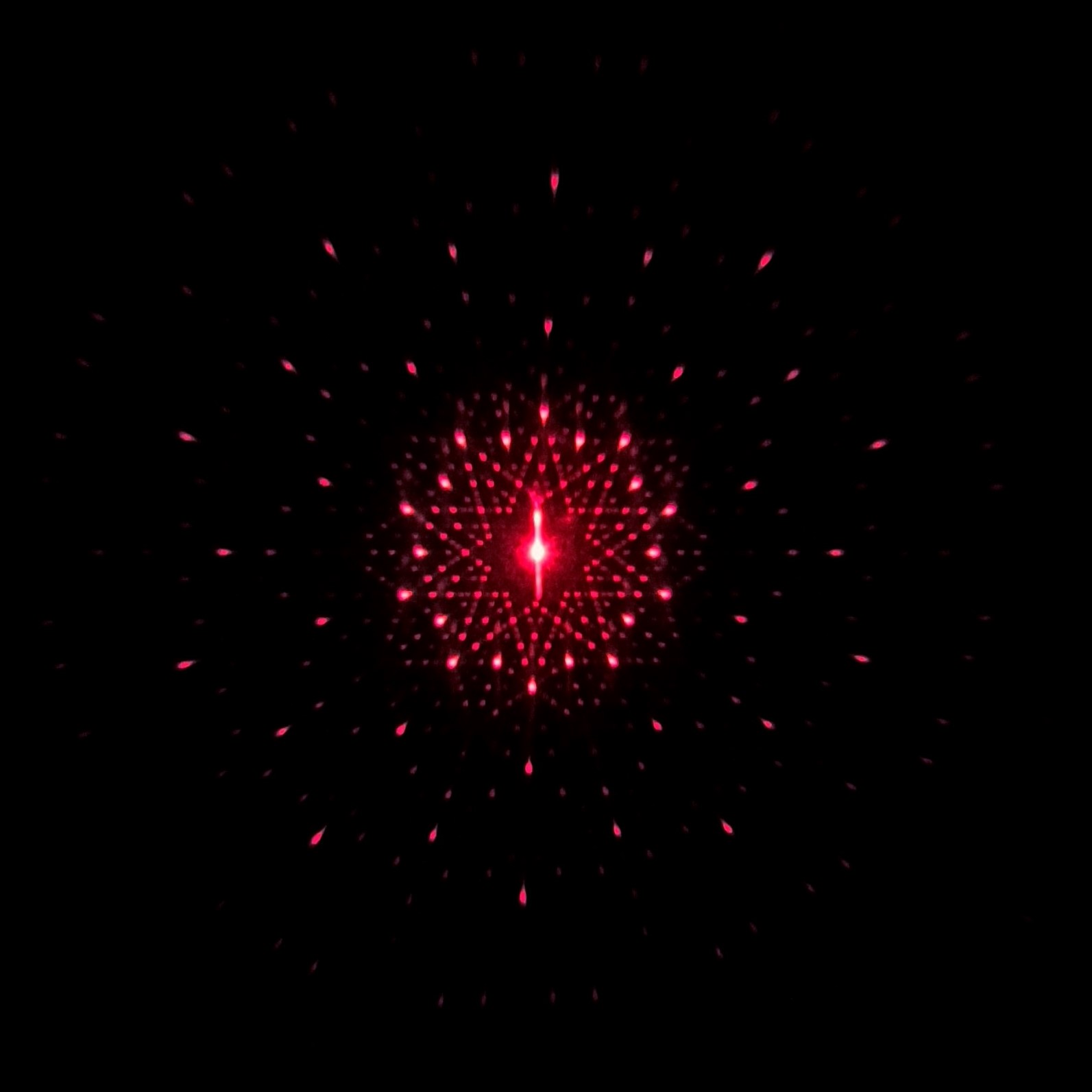
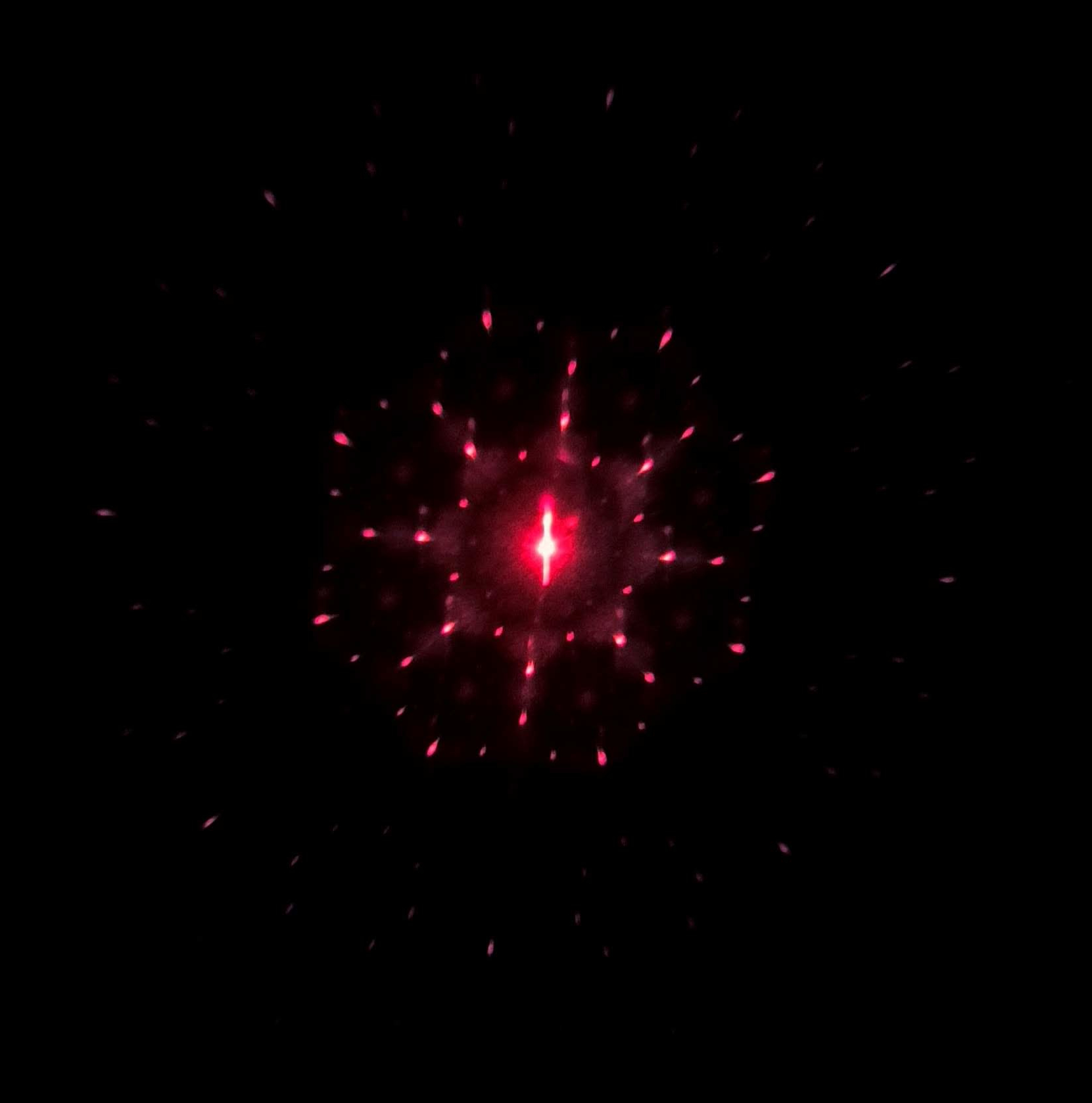
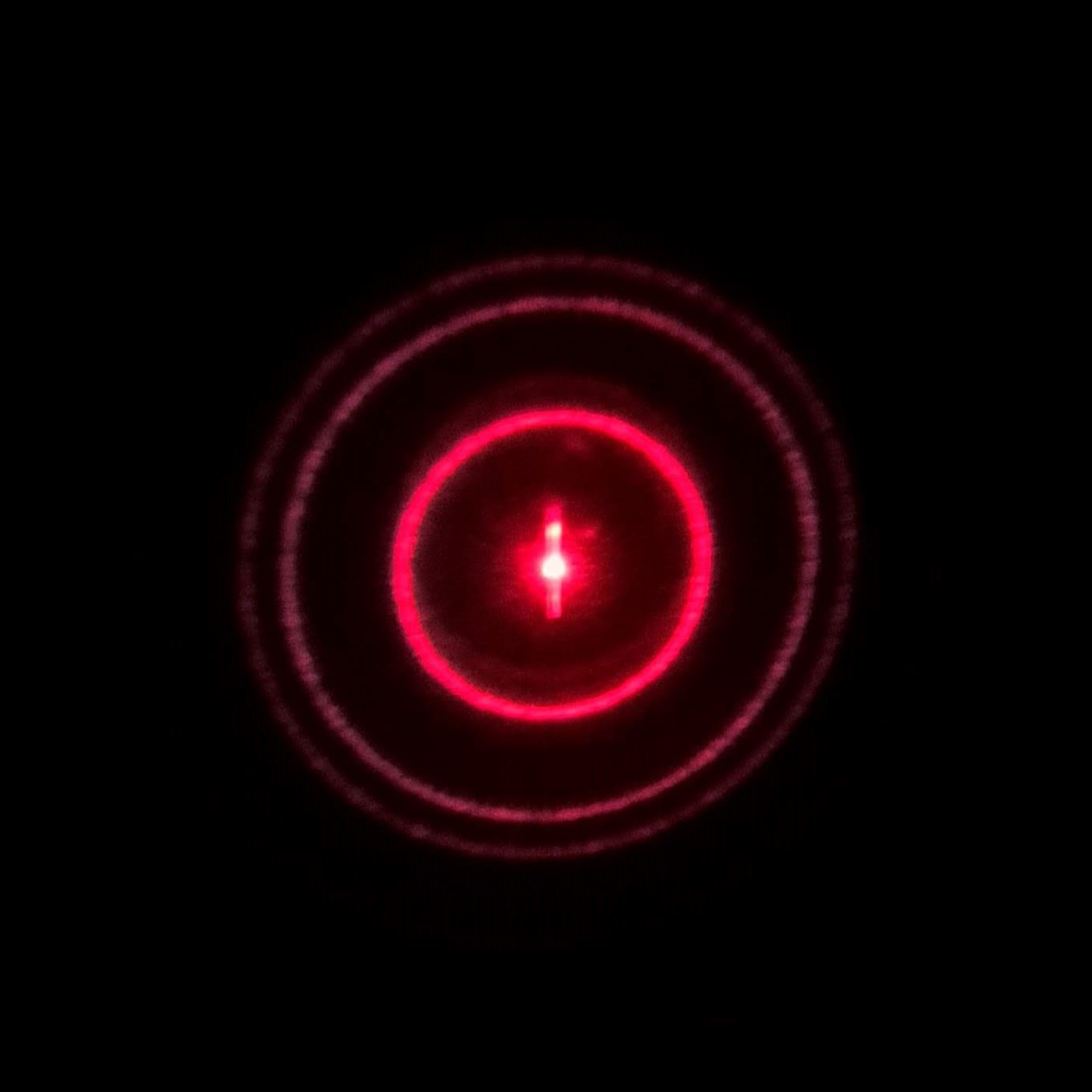
*The images on this page are photos of diffraction patterns of the Penrose tiling (left), an 8-fold symmetric random tiling (center), and the powder diffraction of the square lattice (right), generated via a laser diffractometer. All photos taken by N. Manibo.
Programme and Schedule
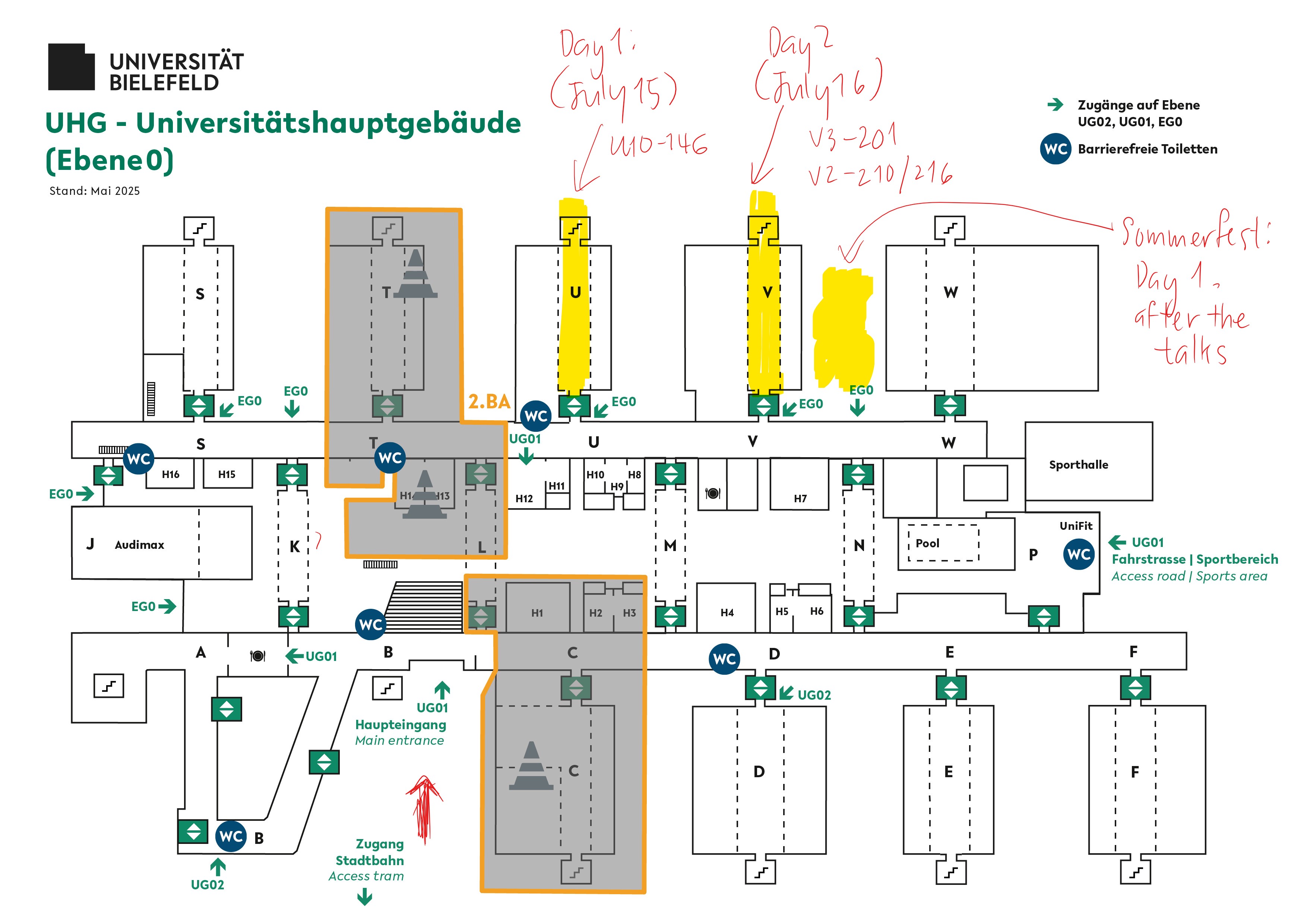
The meeting will move between various rooms (due to the ongoing semester in Bielefeld) in the main university building.
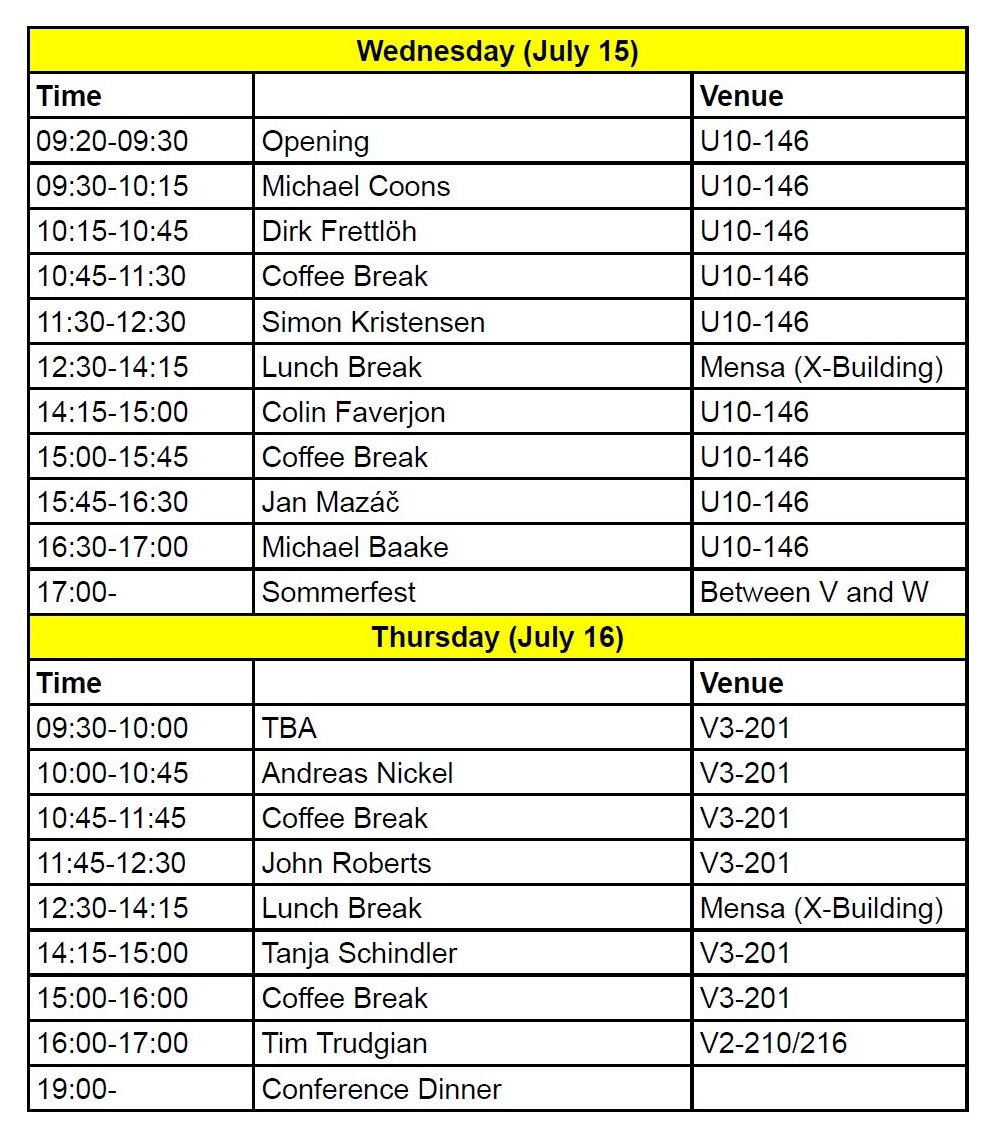
The preliminary programme can be downloaded as a pdf file here: Schedule
Abstracts
Michael Baake (Bielefeld University)
Title: Some extensions of \(\mathcal{B}\)-free systems
Abstract: In this informal contribution, we will explain how Meyer's
theory of weak model sets can be used to understand the long-range
order of \(\mathcal{B}\)-free systems and their lattice-theoretic extensions,
including those with sieves. This can cover examples such as the
carefree integers or the lattice points visible from several
places.
Michael Coons (California State University-Chico/Aarhus University)
Title: A new proof of the singular continuity of the Minkowski $?$-function
Abstract: We give a new proof of the singular continuity of Minkowski's $?$-function. Our proof follows by showing that the maximal Lyapunov exponent of a specific pair of $3\times 3$ nonnegative integer matrices related to Stern's diatomic sequence is strictly greater than $\log 2$.
Colin Faverjon (Université Picardie Jules Verne, Amiens)
Title: Algebraic independence of automatic, morphic numbers and values of $k$-regular series: what remains to be proven?
Abstract: Transcendence results are now well-established for numbers whose expansion in some algebraic base is generated by a regular process, with great generality. These results have been obtained through two independent strategies: one based on Schmidt's $p$-adic subspace theorem, and the other on Mahler's method. The latter not only addresses transcendence but also yields algebraic independence results.
Heuristically, transcendental numbers obtained in this way are algebraically independent, unless the corresponding algebraic bases are essentially identical and the spectral radii of the underlying regular processes coincide.
However, the story does not end here. Even when the algebraic base and spectral radius are fixed, it is still possible to produce algebraically independent numbers. For instance, the numbers whose \(\beta\)-expansions are given by the Baum–Sweet and Thue–Morse sequences, respectively, are algebraically independent. On the other hand, since the values at some given algebraic point of $k$-regular series, $k$ being fixed, form a ring, algebraic independence fails in general.
This leaves us with two open tasks:
To establish criteria for algebraic independence, finer that those based solely on the spectral radius of the underlying process
To provide a complete and effective description of the algebraic relations among these numbers.
Dirk Frettlöh (Bielefeld University)
Title: Frieze patterns on aperiodic tilings of the plane
Abstract: In the 70s Conway and Coxeter introduced a combinatorial pattern of integers supported on a square grid satisfying a certain property on each square: the "diamond rule" - essentially saying that the determinant equals one. These frieze patterns attained lot of interest in recent years. Here we give a first generalization of these Conway-Coxeter frieze patterns to aperiodic strutures by providing two examples of aperiodic frieze patterns of the plane supported on the rhombic Penrose tiling and the Godrèche--Lançon--Billard tiling. That is, we provide a decoration of their vertices with positive integers which satisfy the diamond rule. This is joint work with Jan Mazáč.
Simon Kristensen (Aarhus University)
Title: Arithmetic properties of numbers expressed as series
Abstract: Many famous results and conjectures in the theory of irrationality and transcendence are concerned with numbers which are expressed as series. While most of the famous conjectures are beyond the reach of current methods, it remains an interesting question which arithmetic properties can be deduced directly from starting long and hard at the series in question. In the present talk, I will give a survey of such results, some dating back to seminal results of Erdős and quite a few newer ones obtained by myself in collaboration with my co-authors Maiken Gravgaard, Jaroslav Hančl and Mathias Laursen in various constellations.
Jan Mazáč (Friedrich-Alexander-Universität Erlangen-Nürnberg)
Title: Cantor substitution
Abstract: We analyse a very easy substitution over a two-letter alphabet, which is given by
\[
a \mapsto aaa \quad \text{and}\quad b \mapsto bab.
\]
We discuss its counting autocorrelation and diffraction
(as recently defined by Humeniuk, Ramsey and Strungaru) and show a natural connection
to the classical Cantor set and its approximants. We then provide an explicit formula
of the diffraction measure in the form of a Riesz product and conclude that the
(counting) diffraction is singular continuous. We use these results to further find
another explicit formula for the autocorrelation coefficients.
Andreas Nickel (Universität der Bundeswehr München)
Title: On entropy and symmetries of $k$-free integers in number fields
Abstract: We aim to construct topological dynamical systems with 'small' symmetry group, 'large' extended symmetry group and 'interesting' entropy. We consider higher-dimensional binary shifts of number-theoretic origin. This includes the visible lattice points and the k-free integers in number fields, where we identify an interesting interplay between dynamical and number-theoretic notions. This is joint work with M. Baake, Á. Bustos, C. Huck, and M. Lemańczyk.
John A.G. Roberts (University of New South Wales, Sydney)
Title: The symbolic dynamics and parameter spaces of a piecewise linear map and its related circle map
Abstract:
Lagarias and Rains introduced an area-preserving piecewise-linear map $F_{ab}$ that is defined by applying matrix $A=\begin{pmatrix}a &-1\\ 1&0\end{pmatrix}$ on the left half-plane and applying $B=\begin{pmatrix}b &-1\\ 1&0\end{pmatrix}$ on the right half-plane, so the associated parameter space is $(a,b)$. This map sends the set of rays from the origin to itself and induces a homeomorphism $f_{ab}$ of the unit circle. The natural parameter space of a circle map with the simplest symbolic dynamics of 2 symbols is $(\theta, \rho)$ where $\theta$ is the rotation number and $\rho$ is the density of one of the symbols in the infinite word associated with the circle map's orbits. For $f_{ab}$, $\theta$ and $\rho$ are in general unknown functions of $a,b$. Nevertheless, we can begin to explore what part of the $(\theta, \rho)$ space is accessible to $f_{ab}$, which is a manifestation of the constraints on the rotational language induced by the (symbolic) dynamics of $F_{ab}$. Continued fractions and Diophantine approximation play an important role in our analysis.
This is joint work with Franco Vivaldi (Queen Mary, London) and Asaki Saito (Future University Hakodate).
Tanja I. Schindler (University of Exeter/Jagellonian University, Krakow)
Title: Diffraction, spectral and fractal analysis of (generalized) Thue--Morse measures and applications to large deviations
Abstract: The classic Thue–Morse measure is a paradigmatic example of a purely singular continuous probability measure on the unit interval. Since it has a representation as an infinite Riesz product, many aspects of this measure have been studied in the past. Some of the difficulties emerge from the appearance of an unbounded potential in the thermodynamic formalism. In the generalized case, we consider Riesz products that can be regarded as diffraction measures of generalized Thue–Morse sequences, possibly over an infinite alphabet. These measures are closely related to the dynamical system arising from the doubling map together with an observable exhibiting a logarithmic singularity. For this system, we develop a generalized thermodynamic formalism beyond the standard setting, which yields explicit formulas for Birkhoff and dimension spectra. A further novel aspect is the identification of a precise connection between these spectra and the $L^q$ -spectrum of the underlying Riesz product. If time allows I will also give a link to the Fourier and quantization dimension. Moreover, this new formulation of the thermodynamic formalism allows to give precise large deviation results for unbounded observables with a qualitatively different result depending if the logarithmic singularity appears at a periodic or pre-periodic non periodic point. The talk is based on joint work with Philipp Gohlke and Marc Kesseböhmer and work in progress with Matt Nicol.
Tim Trudgian (University of New South Wales, Canberra)
Title: I’ve got Euclid’s, I’ve got Al Gore, I’ve got Rhythm, who could ask for anything more?
Note: This talk will be given as part of the Bielefeld Mathematical Colloquium
Abstract: Inspired by Gershwin, the title refers to the oldest (?) mathematical algorithm: Euclid’s algorithm for division. This allows us to divide two numbers, keep track of remainders, and recover GCDs. I will discuss other algebraic settings: some rings are known to be Euclidean (meaning they have this algorithm), some are known not to be; many are unknown. I will end with a summary of recent work done by Bagger, Booker, Kerr, McGown, Starichkova, and me, that resolves completely the case of cyclic cubic fields.
Registration is not required, however, the organisers would appreciate if you send an e-mail () in case you intend to participate.
Location, Travel, and Accommodation
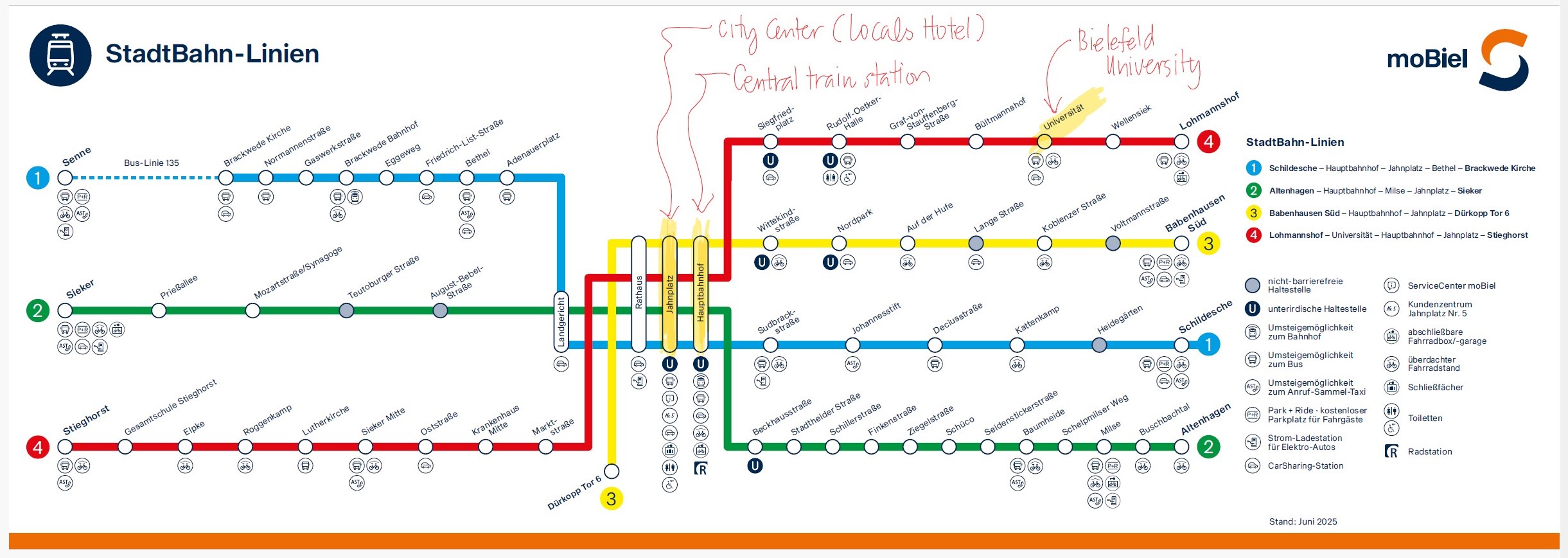
Travel information to and from the university may be found here. To go from the station or from the city centre to the University and vice versa, use the underground ("Stadtbahn"). Take underground line no. 4 (direction "Lohmannshof") to the stop "Universität".
Update: the so-called "4-er Ticket" for four rides is now obsolete (since November 2025). One can only buy single tickets (either from ticket machines or via the MoBiel app), which are automatically validated. The standard single journey ticket ("Einzelticket": valid for 90 Mins, transfers allowed) costs 3.60 EUR while a short trip ticket ("Kurzstrecke": 4 stops, no transfer) costs 2.00 EUR.
For those staying for the entire week, one could consider buying a 7-day ticket "7 TageTicket" for 28.80 EUR.
Here is a list of hotels within the city centre and the respective tram stops closest to them.
There might also be apartments available in the student accommodation complex at Morgenbreede, which is in a walking distance of the campus. The rooms and other details can be seen here.
For those considering booking their accommodation through AirBnB, apart from those at the city centre, there might be additional options close to the tram stops along line 4 (e.g., close to Rudolf-Oetker Halle or Siegfriedplatz).