The representation dimension of artin algebras

Survey, preliminary version (March 4, 2008)


The representation dimension of an artin algebra was introduced by Maurice Auslander in his famous Queen Mary Notes. Recent investigations indicate that one should rescale this invariant (by subtracting 2), this we will call the normalized representation dimension.

Endomorphism rings of modules which are both generators and cogenerators

Note:

Theorem (Morita, Tachikawa): There is a bijection between

defined as follows:

Remark: Let us stress that under this correspondence, the second entry of the pairs in question remains untouched, at least set-theoretically: the second entry is a bimodule and the bijection yields a mutual change of the module action to be considered. Thus, we deal with a typical double-centralizer assertion (in particular, the theorem asserts that the modules M and N considered are balanced).

Iyama's finiteness theorem

Theorem (Iyama [Iya03a]). Given any A-module X, there is an A-module X' such that the endomorphism ring of the direct sum of X and X' is quasi-hereditary.

Iyama's proof provides an explicit construction of such a module X'.

Theorem (Cline-Parshall-Scott). A quasi-hereditary algebra has finite global dimension.

Corollary: For any artin algebra A, there is a module M which is both a generator and a cogenerator such that EndA(M) has finite global dimension.

The normalized representation dimension n.rep.dim.A is defined as follows:

(The representation dimension rep.dim. as defined by Auslander is rep.dim.A = 2+n.rep.dim.A; some authors use deviating values for semi-simple algebras: Rouquier [Rou06] defines the representation dimension of a semisimple algebra to be 2.)

Iyama's upper bound

(Iyama [Iya03b], Theorems 2.2.2 and 2.7.1) Given an A-module M, let δM = M(rad EndA(M)). Note that for M ≠ 0, it is clear that δM is a proper submodule of M, thus δiM = 0 for large i. Let M' be the direct sum of the modules δi(M)).

This can be used in order to provide an upper bound for n.rep.dim.Λ in terms of the Loewy length LL(Λ) for some algebras Λ.
Recall that LL(Λ) is the smallest number n such that (rad A)n = 0.
For example:

The Auslander Lemma

Lemma (Auslander; see [EHIS04], [CP04]). Let M be a generator-cogenerator and d ≥ 0. The global dimension of EndA(M) is at most d+2 if and only if any A-module X has an M-resolution of length d [this means: there exists an exact sequence
0 → Md → ... → M1 → M0 → X → 0
with all Mi in add M, such that the sequence remains exact when one applies HomA(M,-); sometimes one call this a "universal" M-resolution].

Second formulation: Given a module X, let ΩM(X) be the kernel of a minimal right M-approximation of X. Then gl.dim.EndA(M) ≤ d+2 if and only if ΩMd(X) belongs to add M for any module X.

Properties of the representation dimension

Warnings


Other notions of dimensions related to the representation dimension

1. The dimension of a subcategory of a triangulated category

Let T be a triangulated category. Assume there are given classes I, I1 and I2 of objects in T. The main triangulated categories which one consideres are the bounded derived category Db(mod A) of the category of finite length A-modules, as well as the stable module category mod A of a self-injective algebra A.

2. The weak resolution dimension of an artin algebra

Definition: Let M be a module. A weak M-resolution of length d of the module X is an exact sequence
0 → Md → ... → M1 → M0 → X → 0
with Mi in add M for all i. The weak resolution dimension of Λ is the smallest number d for which there exists a module M such that any Λ-module X has a weak M-resolution of length d.

Comparison

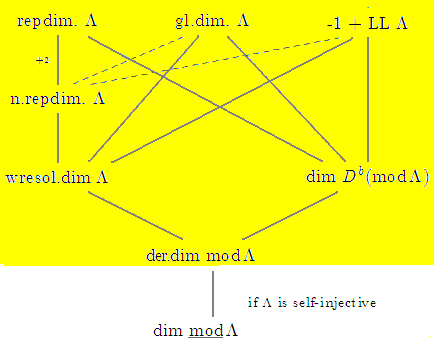
The solid lines indicate inequalities,
the dashed ones are conjectured inequalities
(the yellow part concerns all artin algebras, the lower white part the self-injective ones).
References for the various inequalities:
  • wresol.dim ≤ n.rep.dim.: This is a consequence of the Auslander-Lemma.
  • wresol.dim ≤ gl.dim.: This is the special case of M being the regular representation.
  • wresol.dim ≤ -1 + LL: Let LL Λ = n, and Λ(t) = Λ/Jt, where J is the radical. Take as M the direct sum of the Λ-modules Λ(t). For any Λ-module X of Loewy length at most t, the module X' = ΩΛ(t) X has Loewy length at most t-1. This shows that any Λ-module has a weak M-resolution of length n-1.
  • dim mod Λ ≤ wresol.dim Λ ([Opp07b], 1.9)
  • dim mod Λ ≤dim Db(mod Λ): dimension inequality for subcategory inclusions ([Opp07b], 1.8)
  • dim Db(mod Λ) ≤ 2 + n.rep.dim Λ ([Rou06], 3.7, [KK06], 3.4, [Opp07b], 1.14)
  • dim Db(mod Λ) ≤ gl.dim Λ ([Rou06], 3.7 und [KK06], 2.6, [Opp07b], 1.12, 1.13)
  • dim Db(mod Λ) ≤ -1+LL Λ ([Opp07b], 1.10, 1.11)

  • Λ self-injective: mod Λ ≤ dim mod Λ ([Opp07b], 1.15)
Special values of the representation dimension: n.rep.dim.(A) = 0 or 1.

n.rep.dim.(A) = 0

Theorem (Auslander). n.rep.dim.(A) ≤ 0 if and only if A is representation-finite. Such an algebra has a unique multiplicityfree module M which is a generator-cogenerator and such that the global dimension of its endomorphism ring is at most 2, namely the direct sum of all indecomposable modules.

Usual formulation: There is a bijection between the Morita classes of artin algebras A which are representation-finite and the Morita equivalence classes of artin algebras B with gl.dim.B ≤ 2 and dom.dim.B ≥ 2.

n.rep.dim.(A) ≤ 1

Recall that the Auslander Lemma asserts: n.rep.dim.(A) ≤ 1 iff there exists a module M such that ΩM(X) belongs to add M, for any A-module M (here, ΩM(X) is the kernel of a minimal right (add M)-approximation of X).

If n.rep.dim.(A) ≤ 1, then a subcategory A of mod Λ will be called an Auslander subcategory provided it is finite, contains all projective modules, all injective modules, and gl.dim.EndA(M) ≤ 3, where add M = add A.

Here are examples of artin algebras with n.rep.dim.(A) ≤ 1;
if possible, we also mention a typical Auslander subcategory in each case.


Lower bounds

This is the essential new development! (Rouquier, Krause-Kussin, Oppermann, Bergh-Oppermann, Bergh, ...)

Oppermann's Lattice Theorem ([Opp07a]). Let k be a field, let Λ be a finite dimensional k-algebra,
let R be a polynomial ring over k in finitely many variables,
Let L be a Λ (\otimes)k R-lattice.
Assume that the set of all maximal ideal p of R such that

(L (\otimes)R -) (ExtRd(finlength(Rp), finlength(Rp)) ≠ 0
is Zariski-dense in the maximal spectrum of R, then
n.rep.dim.Λ ≥ d.

The main examples

  • The exterior algebras (Rouquier) [Rou06]:
    Let V be an n-dimensional vectorspace and ΛV its exterior algebra. Then
    n.rep.dim.ΛV = n-1.
    (see [Rouo6] and also [Opp07a])

    The truncated exterior algebras (Oppermann)
    Again, let V be an n-dimensional vectorspace and ΛV its exterior algebra.
    Let J be the radical of ΛV. Let 2 ≤ L < dim V. Then

    n.rep.dim.ΛV/JL = L-1.
    (see [Opp07a] Example 5.1 and Appendix A.5).

  • The truncated symmetric algebras (Oppermann)
    Let V be an n-dimensional vectorspace and ΣV its symmetric algebra (thus, ΣV is the polynomial ring in n generators).
    Let J be the ideal of ΣV generatied by V, and 2 ≤ L. Then
    If L ≤ n, then n.rep.dim.ΣV/JL = L-1.
    If L > n, then n.rep.dim.ΣV/JL ≥ n-1.
    (Oppermann suggests that one may have equality.)
    (see [Opp07a] Example 5.2 and Appendix A.8 (and also Krause-Kussin [KK06]).


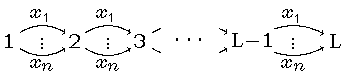
    We consider now the following quiver QL,n with
    • L vertices, labelled 1, 2, ..., L,
    • and n arrows from i+1 to i (for 2 ≤ i ≤ L), always labelled x1, ..., xn

  • The truncated graded exterior algebras (Oppermann).
    Consider the path algebra of the quiver QL,n with L ≥ 2,
    modulo the ideal I generated by the relations xi2, and xixj + xjxi (for all possible i,j).
    n.rep.dim. kQL,n/I = min(L-1,n-1).
    (see [Opp07a] Example 6.2 and Appendix A.6).

  • The truncated graded symmetric algebras (Oppermann), these algebras are also called Beilinson algebras.
    Consider the path algebra of the quiver QL,n with L ≥ 2,
    modulo the ideal I generated by the relations xixj - xjxi (for all possible i,j).
    If L ≤ n, then n.rep.dim. kQL,n/I' = L-1.
    If L > n, then n.rep.dim. kQL,n/I' ≥ n-1.
    (see [Opp07a] Example 6.2 and Appendix A.7).


Commutative artin algebras

  • Theorem (Oppermann) [Opp07a]. Consider the polynomialring R = k[xn,...,xn] in n variables (n ≥ 1),
    and let J be the ideal of R generated by x1,...,xn.
    Let I be a cofinite ideal of R which is contained in JL. Then
    n.rep.dim. R/I ≥ min(n-1,L-1)

  • Complete intersections (Bergh):
    Let Λ be a finite-dimensional commutative k-algebra of the form Λ = S/I, where S is the polynomial ring over a field k in the variables x1,...,xn and I is an ideal with n generators; such an algebra is always self-injective).
    n.rep.dim. S/I ≥ n-1
    (see [Ber07]. Algebras of this kind have been considered before by Avramov and Iyengar (unpublished). For the case when Λ is the group algebra of an elementary abelian p-group of rank n, see also [Opp07b].)


Non-commutative analoga

  • Quantum complete intersections (Bergh-Oppermann):
    Let n ≥ 1 and k a field. Let S be the free k-algebra generated by x1,...,xn.
    Take natural numbers a(i) ≥ 2 and elements qij ≠ 0 in k, for all 1 ≤ i < j ≤ n.
    Let I be the ideal of S generated by the elements xia(i) for all i and xixj - qijxjxi for all i < j.
    (Note that S/I is commutative if and only if qij = 1 for all i,j.)
    Then
    n.rep.dim. S/I ≤ 2n-2.

    If one assumes in addition that a(i) = a for all i, and that qij = q is a primitive a-th root of unity, then

    n-1 ≤ n.rep.dim. S/I ≤ 2n-2.
    (see [BO07].)

  • Quantum exterior algebras (Bergh):
    Let Λbe a finite-dimensional commutative k-algebra of the form Λ = S/I, where S is the free algebra in the variables x1,...,xn and I is the ideal generated by the elements x12 and xixj - qijxjxi for all i < j.
    If we assume that all the elements qij are roots of unity, then
    n.rep.dim. S/I = n-1

Further classes of artin algebras

  • Theorem (Krause-Kussin) [KK06]: Let X be a reduced projective scheme with a tilting complex T (in Db(coh X)). Then
    n.rep.dim.End(T) ≥ -2 + dim X.

  • Theorem (Oppermann) [Opp07b]: Let k be a field with characteristic p > 0, let G a finite group.
    Let B be a block of the group algebra kG and D a defect goup of B. Then
    n.rep.dim. B ≥ -1 + p-rank(D).


Relationship between representation dimension and the homological conjectures

Further use of the representation dimension


References
Anyone is invited to send remarks (corrections, additions) to C.M.Ringel.