

Organizers: Ferdinando Cicalese (Salerno) und Christian Deppe (Bielefeld)


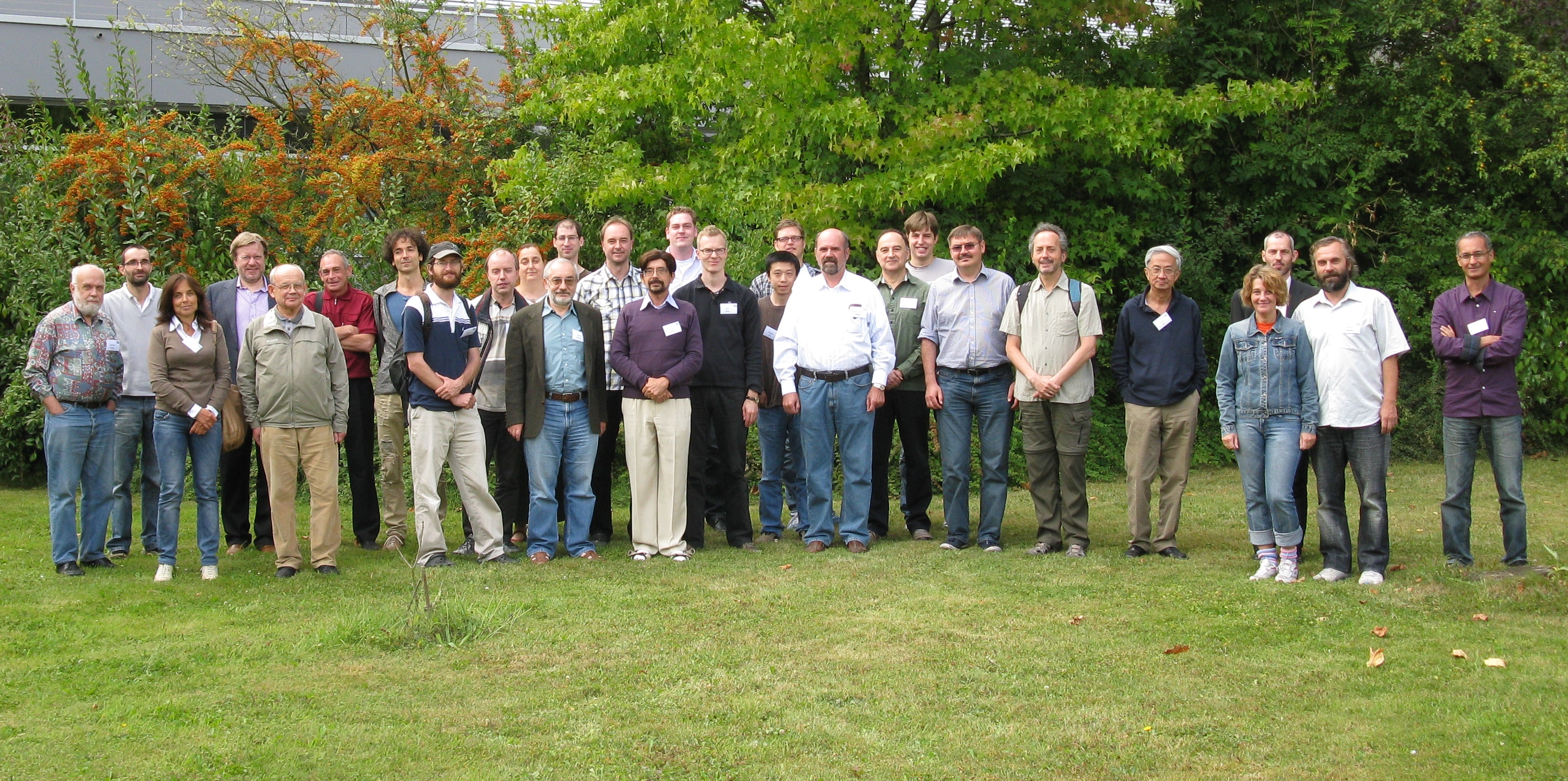
Perhaps the most natural example of a search problem is the task to find an unknown element in a finite set by asking questions concerning containment in a subset. There has been an explosion of developments in search for instance in Computer Science, Image Reconstruction, Machine Learning, Information Theory (classical and quantum theoretical), and Operation Research. Time seems to be mature for more theoretical understanding with the goal of a general Theory of Search, since there are already parallels in methods in different disciplines like data transmission over noisy channels with feedback corresponds to search with random answers and foraging of animals corresponds to search for information in the internet.
A search structure is defined by a space of objects searched for and a space of tests (questions).
In specifying a search problem performance criteria have to be chosen.
Furthermore we distinguish combinatorial and probabilistic models.
Especially important is the study of adaptive and non-adaptive
strategies as well as the analysis of their intermediate forms.
There is reason for optimism. Three decades ago it was often asked whether search is a scientific subject!
Confirmed Participants
| NAME | DEPARTMENT | AFFILIATION |
|---|---|---|
| Aldridge, Matthew | School of Mathematics | University of Bristol, UK |
| Althöfer, Ingo | Department of Mathematics | University of Jena |
| Aydinian, Harout | Department of Mathematics | University of Bielefeld |
| Balkenhol, Bernhard | Infinity 3 GmbH, Bielefeld | |
| Blinovsky, Vladimir | Institute of Information Transmission Problems | Russian Academy of Sciences, Moscow |
| Bodewig, Michael | Department of Mathematics | Aachen University |
| Cai, Minglai | Department of Mathematics | University of Bielefeld |
| Cai, Ning | The State Key Lab. of ISN | Xidian University, Xi'an, China |
| Chang, Hulian | Department of Applied Mathematics | National Chiao Tung University, Hsinchu, Taiwan |
| Cheraghchi, Mahdi | Computer Science Department | Carnegie Mellon University, Pittsburgh, USA |
| Cicalese, Ferdinando | Department of Computer Science | University of Salerno, Italy |
| Czabarka, Eva | Department of Mathematics | University of South Carolina, USA |
| Damaschke, Peter | Computer Science and Engineering | Chalmers University, Göteborg, Sweden |
| De Bonis, Annalisa | Department of Computer Science | University of Salerno, Italy |
| De Marco, Gianluca | Department of Computer Science | University of Salerno, Italy |
| Deppe, Christian | Department of Mathematics | University of Bielefeld |
| Dress, Andreas | Key Lab for Computional Biology | Shanghai |
| Dyachkov, Arkadii | Institute of Information Transmission Problems | Russian Academy of Sciences, Moscow |
| Gasieniec, Leszek | Department of Computer Science | University of Liverpool, UK |
| Janssen, Gisbert | Department of Electrical Engineering | Technical University of Munich |
| Kabatyansky, Grigory | Institute of Information Transmission Problems | Russian Academy of Sciences, Moscow |
| Katona, Gyula | Renyi Institute | Hungarian Accademy of Sciences |
| Konstantinova, Elena | Institute of Mathematics, Siberian Branch | Russian Academy of Sciences, Novosibirsk |
| Kranakis, Evangelos | School of Computer Science | Carleton University, Canada |
| Kucherov, Gregory | Laboratoire d'Informatique Gaspard Monge | Universite Paris-Est |
| Lebedev, Vladimir | Institute of Information Transmission Problems | Russian Academy of Sciences, Moscow |
| Liptak, Zsuzsanna | Dept. of Computer Science | University of Verona, Italy |
| Lorenz, Ulf | Fachbereich Mathematik | Technische Universitaet Darmstadt |
| Malioutov, Mikhail | Department of Mathematics | Northeastern University, USA |
| Polyansky, Nikita | Institute of Information Transmission Problems | Russian Academy of Sciences, Moscow |
| Porat, Ely | Department of Computer Science | Bar-Ilan University, Israel |
| Reischuk, Rüdiger | Institut für Theoretische Informatik | Universität zu Lübeck |
| Riis, Soren | School of Electronic Engeneering and Computer Science | Queen Mary, University of London, UK |
| Rudra, Atri | Department of Computer Science & Engineering | The State University of New York, USA |
| Rykov, Vyacheslav | Department of Mathematics | University of Nebraska-Omaha, USA |
| Stoye, Jens | Department of Computer Sciences | University of Bielefeld |
| Szekely, Laszlo | Department of Mathematics | University of South Carolina, USA |
| Tamm, Ulrich | German Language Department of Business Informatics | Marmara University, Istanbul, Turkey |
| Teytaud, Olivier | INRIA Saclay | Ile-de-France |
| Triesch, Eberhard | Lehrstuhl II für Mathematik | RWTH Aachen |
| Wiener, Gabor | Renyi Institute | Hungarian Accademy of Sciences |