This is the fifth instalment of the THGT conference series. As its predecessors, the conference takes place in Bielefeld in spring, and as before it welcomes researchers studying groups through their interactions with topology and homology, as well as people interested in entering the subject.
Organisers: Benjamin Brück, Kai-Uwe Bux, Hermes Lajoinie-Dodel and Stefan Witzel.
Contact / Mail: thgt26@math.uni-bielefeld.de
THIS CONFERENCE IS SUPPORTED BY


Funded by the Deutsche Forschungsgemeinschaft (DFG, German Research Foundation) -- SFB-TRR 358/1 2023 -- 491392403
This conference has received funding from the European Union (ERC, SATURN, 101076148)
Invited Speakers
- Herbert Abels
- Tara Brendle
- Ilaria Castellano
- Laura Ciobanu
- Steffen Kionke
- Nicolas Monod
- Andy Putman
- Ric Wade
- Henry Wilton
Programme
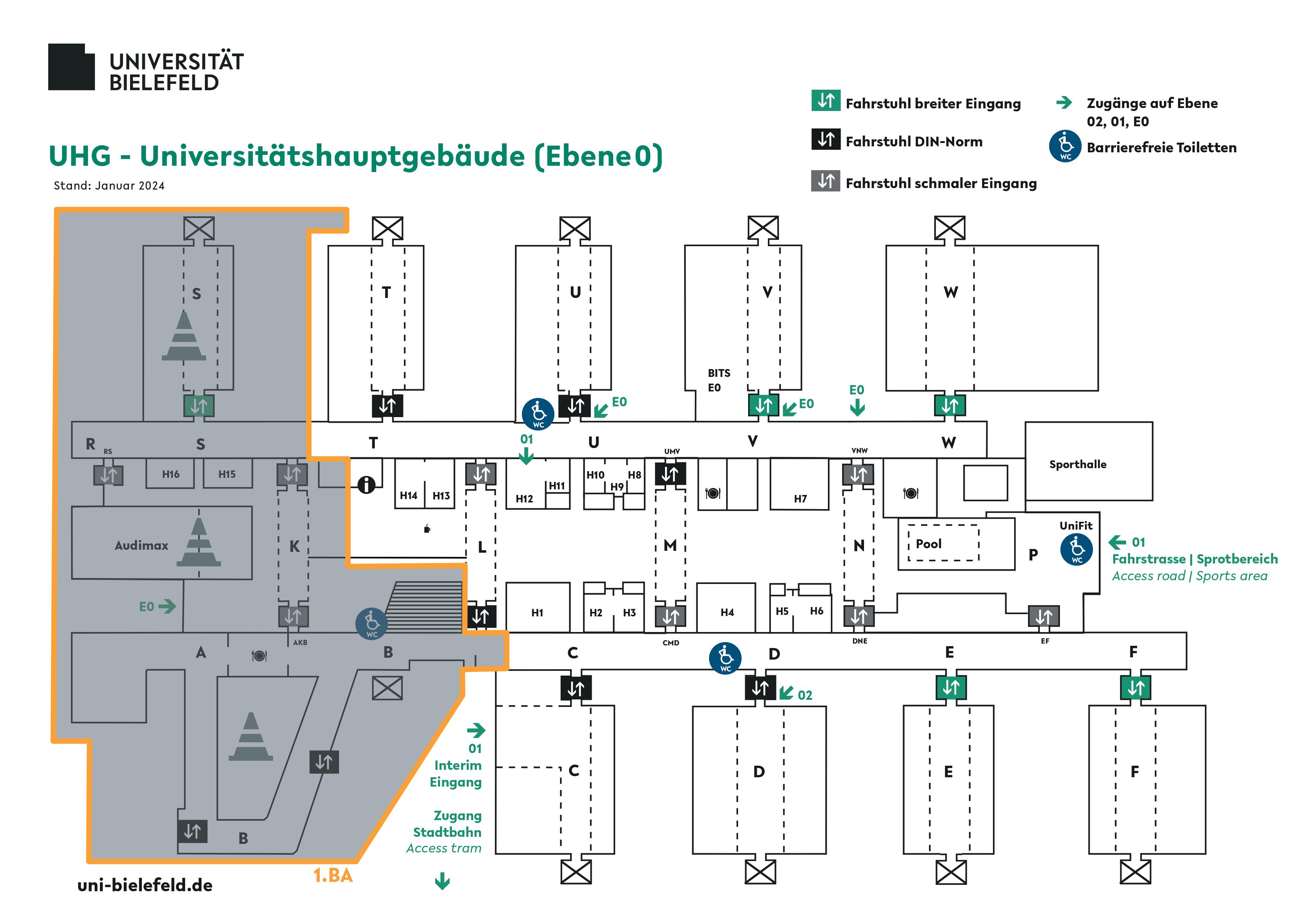
All presentations this week will take place in Room H16 of the main building.
The conference dinner will be at Finca at 7 PM on Thursday, March 26.
| Time | Title | Speaker |
|---|---|---|
| Monday, 23.03 | ||
| 09:00 - 10:00 | Registration | |
| 10:00 - 11:00 | The kernel of the Birman-Craggs-Johnson homomorphism | Tara Brendle |
| 11:00 - 11:30 | Coffee Break | |
| 11:30 - 12:30 | Combinatorial complexes and cohomology | Ric Wade |
| 12:30 - 14:00 | Lunch | |
| 14:00 - 14:30 | Group homology and dynamics of disconnected spaces | Georg Lehner |
| 14:45 - 15:15 | Coherence of group pairs | Pablo Sánchez-Peralta |
| 15:15 - 16:00 | Coffee Break | |
| 16:00 - 16:30 | From finiteness properties to polynomial filling via homological algebra | Jannis Weis |
| Tuesday, 24.03 | ||
| 09:30 - 10:30 | How to deal with flatmates: control your nerves, consider support | Nicolas Monod |
| 10:30 - 11:00 | Coffee Break | |
| 11:00 - 11:30 | Geometric invariants of TDLC completions | José Pedro Quintanilha |
| 11:45 - 12:15 | Describing the nub in maximal Kac--Moody groups | Sebastian Bischof |
| 12:15 - 14:00 | Lunch | |
| 14:00 - 14:30 | The rational homology of $Out(F_8)$, $Aut(F_7)$ and related groups | Maroš Grego and Tomáš Vitek |
| 14:45 - 15:15 | On the projective span of certain spherical space forms | Baylee Schutte |
| 15:15 - 16:00 | Coffee Break Poster Session | |
| 16:00 - 16:30 | Cohomological Finiteness Properties of Almost Automorphism Groups | Sofiya Yatsyna |
| Wednesday, 25.03 | ||
| 09:30 - 10:30 | Degree of (twisted) commutativity and subgroup growth | Laura Ciobanu |
| 10:30 - 11:00 | Coffee Break | |
| 11:00 - 11:30 | Virtual homological torsion in low dimensions | Jonathan Fruchter |
| 11:45 - 12:15 | Cobordism, spin structures, and profinite completions | Andrew Ng |
| Thursday, 26.03 | ||
| 09:30 - 10:30 | Surfaces and cubulated groups | Henry Wilton |
| 10:30 - 11:00 | Coffee Break | |
| 11:00 - 11:30 | Coarse higher medians in higher-rank symmetric spaces | Grazia Rago |
| 11:45 - 12:15 | JSJ decompositions of Artin groups | Oli Jones |
| 12:15 - 14:00 | Lunch | |
| 14:00 - 14:30 | Cohomological characterisations of groups with low rank representations over a number field. | Robynn Corveleyn |
| 14:45 - 15:45 | Profiniteness of higher rank volume | Steffen Kionke |
| 15:45 - 16:30 | Coffee Break | |
| 16:30 - 17:00 | Probabilistic identities, analytic groups and free constructions. | Nowras Otmen |
| Friday, 27.03 | ||
| 09:30 - 10:30 | Lyndon-Hochschild-Serre Spectral Sequences | Ilaria Castellano |
| 10:30 - 11:00 | Coffee Break | |
| 11:00 - 12:00 | The second rational homology of the Torelli group | Andy Putman |
Abstracts
CANCELLED: The Frattini subgroup of a Lie group and the topological rank of a Lie group.
How many elements of a given connected Lie group $G$ do you need to generate a dense subgroup of $G$? This number is called the topological generating rang $d_{\text{top}}(G)$ of $G$. I will present joint work with G. Noskov where we compute this number. Several special cases have been known before. E.g. for a linear semisimple Lie group G the classical result $d_{\text{top}}(G) = 2$ has been improved to ”$d_{\text{top}}(G)$ is slightly bigger than one”, in joint work with E.B. Vinberg. A basic tool to compute $d_{\text{top}}(G)$ in general is the subgroup of elements you do not need as generators, which is called the Frattini subgroup. Computing modulo (a normal subgroup of) the Frattini group simplifies our problem. But the Frattini subgroup is an interesting object in its own right.Describing the nub in maximal Kac--Moody groups
Let $G$ be a totally disconnected locally compact (tdlc) group. The contraction group $\mathrm{con}(g)$ of an element $g\in G$ is the set of all $h\in G$ such that $g^n h g^{-n} \to 1_G$ as $n \to \infty$. The nub of $g$ can then be characterized as the intersection $\mathrm{nub}(g)$ of the closures of $\mathrm{con}(g)$ and $\mathrm{con}(g^{-1})$. Contraction groups and nubs provide important tools in the study of the structure of tdlc groups, as already evidenced in the work of G.~Willis. It is known that $\mathrm{nub}(g) = \{1\}$ if and only if $\mathrm{con}(g)$ is closed. In general, contraction groups are not closed and computing the nub is typically a challenging problem. Maximal Kac--Moody groups over finite fields form a prominent family of non-discrete compactly generated simple tdlc groups. In this talk we give a complete description of the nub of any element in these groups. This is joint work with Timothée Marquis.The kernel of the Birman-Craggs-Johnson homomorphism
tbaLyndon-Hochschild-Serre Spectral Sequences
TDLC stands for totally disconnected locally compact. A recently emerging guiding principle suggests that, with respect to finiteness conditions, TDLC completions behave similarly to group quotients. Pursuing this idea, we use a method of P. H. Kropholler to generalise the Lyndon–Hochschild–Serre spectral sequence associated with a group extension K→G→Q. In our setting, the normal subgroup K is replaced by a G-stable local filter S, and the quotient group Q by the TDLC completion $\hat G_S$. The aim of this talk is to show how this framework provides a bridge relating the homological finiteness properties of G to those of $\hat G_S$. We also prove the existence of a Grothendieck spectral sequence over $\mathbb Q$ that generalises the LHS spectral sequence for a group extension K→G→Q in homology, and establish an analogue of Feldman’s theorem for TDLC completions. This is joint work with Elisa HartmannDegree of (twisted) commutativity and subgroup growth
The degree of commutativity of a group $G$ measures the proportion of pairs of commuting elements in $G$, so the number of $(x,y)$ in $G \times G$ such that $xy=yx$, among all pairs of elements in $G$. This is a concept that connects to the standard and conjugacy growth of $G$, and has been studied asymptotically in many classes of infinite groups. In this talk I will introduce a generalization of the above called the `degree of twisted commutativity', which is concerned with the proportion of $(x,y)$ such that $xy=f(y)x$, where $f$ is an automorphism of G. $I$ will show how this connects to twisted conjugacy growth, the Reidemeister number of an automorphism and relative subgroup growth, and present a few results for groups of both polynomial and exponential growth. This is joint work with Corentin Bodart, Gemma Crowe, and Pieter Senden.Cohomological characterisations of groups with low rank representations over a number field.
In this talk, we discuss the study of groups through properties of the unit group of their group ring over the ring of integers $R$ of a number field $F$. In particular, we cover the “worst-behaved” case: (finite) groups such that all irreducible $F$-representations are matrix rings of rank at most 2 over a division algebra. We characterise such groups in terms of cohomological properties (such as small virtual cohomological dimension and Serre’s cohomological goodness property) of the unit group of the group ring over $R$. If time permits, we also touch on characterisations of such groups in terms of a higher Kleinian property. Based on joint work with G. Janssens and D. Temmerman.Virtual homological torsion in low dimensions
A long-standing conjecture of Bergeron and Venkatesh predicts that in closed hyperbolic 3-manifolds, the amount of torsion in the first homology of finite-sheeted normal covers should grow exponentially with the degree of the cover as the covers become larger. In this talk I will explain how a two-dimensional lens offers a clearer view of some of the underlying mechanisms that create homological torsion in finite covers, and how they might relate to its growth.The rational homology of $Out(F_8)$, $Aut(F_7)$ and related groups
Using the forested graph complex of Conant and Vogtmann, we have computed the rational group homology of $Out(F_8)$, $Aut(F_7)$ and several other groups related to homotopy auto-equivalences of graphs. We have found multiple non-trivial homology classes, which have appeared rather scarcely in the homology of $Out(F_n)$ thus far, although we know that, asymptotically, their number grows super-exponentially. $F_8$ seems to be at the border before this explosion of non-trivial classes occurs. We have also made several theoretical simplifications of the complex, related to connectivity and girth of the graphs, which eased the computational load and allowed us to find representatives of some of the classes with a very small number of non-zero entries. Joint work with Thomas Willwacher.JSJ decompositions of Artin groups
Artin groups are a rich class of groups generalising Braid groups and closely related to Coxeter groups. In this talk I will present a characterisation of which Artin groups split over infinite cyclic subgroups, leading to an explicit JSJ decomposition of Artin groups over infinite cyclic subgroups. I will then discuss how tools related to the JSJ decomposition can be used to extract information about the (outer) automorphism groups of certain Artin groups, such as their finiteness properties. The talk is partially based on joint work with Giorgio Mangioni and Giovanni Sartori.Profiniteness of higher rank volume
A property of a finitely generated residually finite group is „profinite", if it is detected by its finite quotients (i.e. by the profinite completion). Profinite properties received a lot of attention recently. In particular, arithmetic groups with the congruence subgroup property (CSP) provide plenty of fruitful examples. After a short introduction to profinite properties, I will explain why the covolume of an irreducible lattice with CSP in a higher rank semisimple Lie group is profinite. Even without relying on CSP, one can show that volume is a profinite invariant of octonionic hyperbolic congruence manifolds. The talk is based on joint work with Holger Kammeyer and Ralf Köhl.Group homology and dynamics of disconnected spaces
Recent work by Xin Li on ample groupoids has made exciting connections between topological dynamical systems, algebraic K-theory and the group homology of so called topological full groups, among which the Higman-Thompson groups arise as particularly natural examples. In this talk we will elaborate on how the notion of ample groupoids relates several different examples: 1.) The dynamics of a group acting on a measure space. 2.) The scissors congruence group of polytopes in n-dimensional euclidean, spherical or hyperbolic space. 3.) Algebraic K-theory of totally disconnected spaces. 4.) A purely homological criterion of amenability of a (discrete) group.How to deal with flatmates: control your nerves, consider support
I will describe the "flatmate" complex for buildings. For pictures and for the intuition, we can also just think of trees. The goal is to understand this complex for its own interest, even though it arose as a tool to determine the bounded cohomology of algebraic groups. The main ideas for this will be to revisit some basic topological notions for simplicial complexes, such as "nerve" principles, and to pay particular attention to the "support" of chains or cycles.Cobordism, spin structures, and profinite completions
A surprising theorem of Wilton-Zalesski says that the geometric structure of a geometric 3-manifold can be determined purely from the set of finite quotients of its fundamental group, or equivalently the profinite completion. This raises the question of what other geometric and topological invariants can be seen in the profinite completion. Recall that the Stiefel-Whitney classes of a manifold are characteristic classes in mod 2 cohomology that detect important properties, such as orientability, the unoriented bordism class, and admitting a spin structure. In joint work with Sam Hughes, we show that for compact aspherical manifolds with fundamental group that is good in the sense of Serre, these characteristic classes are invariants of the profinite completion. This raises the possibility of applications to questions of profinite rigidity, and as a sample application we are able to show the profinite rigidity of the fundamental group of a flat 6-manifold.Probabilistic identities, analytic groups and free constructions.
Profinite groups can be endowed with a probability measure, which allows one to investigate probabilistic questions in this class of topological groups. A particularly interesting instance is that of a group with a probabilistic identity, that is, when a group satisfies a word with positive probability. In this presentation, I will talk about the structural implications of satisfying a probabilistic identity in two classes of groups: analytic groups and fundamental groups of graphs of pro-p groups. This is joint work with Steffen Kionke, Tommaso Toti, Matteo Vannacci and Thomas Weigel.The second rational homology of the Torelli group
I will discuss my recent work with Dan Minahan in which we calculate the second rational homology group of the Torelli group. I will try to make this talk accessible to people who are not experts on the mapping class group.Geometric invariants of TDLC completions
Given a commensurated subgroup $\Lambda$ of a group $\Gamma$, it is in general not possible to construct a quotient group $\Gamma / \Lambda$. But there exist nonetheless a homomorphism $\phi\colon \Gamma \to G$ with dense image to a totally disconnected totally compact (TDLC) group $G$, and a compact open subgroup $L$ of $G$ whose $\phi$-preimage is~$\Lambda$. One such construction is provided by the Schlichting completion. Bonn--Sauer have shown that from the point of view of the compactness properties introduced by Abels--Tiemeyer, Schlichting completions behave precisely as though they were group quotients. Now, these compactness properties are a special case of the so-called $\Sigma$-sets, which have recently been generalized from the discrete setting to locally compact groups by Kai-Uwe Bux, Elisa Hartmann and myself. In my talk, I report on joint work with Ilaria Castellano, where we show that in fact the behaviour of Schlichting completions observed by Bonn--Sauer extends to the $\Sigma$-sets.Coarse higher medians in higher-rank symmetric spaces
To provide a unified framework for median graphs, mapping class groups, and $\mathrm{CAT}(0)$ cube complexes, Bowditch introduced the notion of a coarse median on a metric space. Answering a question of Bowditch, Haettel showed that a higher-rank symmetric space of non-compact type admits a coarse median if and only if it is a product of rank-one spaces. In this talk, we will focus on the family of higher-rank symmetric spaces of noncompact type admitting a convex projective model. While these metric spaces do not admit a coarse median in Bowditch's sense, we will construct a generalized coarse median for them. We will conclude by discussing some properties of our ''coarse higher medians''. This is ongoing joint work with Mitul Islam.Coherence of group pairs
A group is coherent if all its finitely generated subgroups are finitely presented. In 2023, Jaikin-Zapirain and Linton confirmed that one-relator groups are coherent by proving a criterion for coherence of groups of cohomological dimension two. In this talk I will explain how to generalize this criterion to group pairs of cohomological dimension two and show how it can be used to prove that one-relator products of coherent locally indicable groups (of arbitrary dimension) are coherent. This is joint work with Andrei Jaikin-Zapirain and Marco Linton.On the projective span of certain spherical space forms
The projective span of a manifold is the maximal number of linearly independent tangent line fields. This number is not only difficult to compute, but also an important diffeomorphism invariant of manifolds. In this talk, we will discuss our progress towards computing the projective span of certain spherical space forms, i.e., quotients of spheres by a free orthogonal group action. We hope that these results will lead to new information about the so-called "spherical space form problem". This is joint work with Mark Grant.Combinatorial complexes and cohomology
Mapping class groups of surfaces, mapping class groups of handlebodies, and outer automorphism groups of free groups are three closely related families of discrete groups. They acts on combinatorial complexes called the curve complex, the disc complex, and the sphere complex respectively. By work of Harer, the homology of the curve complex is the so-called dualising module for the mapping class group. I shall give an overview of joint work with Dan Petersen which describes how there is a similar relationship between the homology of the boundary of the disc complex and the dualising module of the handlebody group, and joint work with Thomas Wasserman which describes how the relationship between the homology of the boundary of the sphere complex and the dualising module of $Out(F_n)$ is probably not so clean.From finiteness properties to polynomial filling via homological algebra
If a group is of type $FP_n$ one can define its (higher) filling functions, which give a quantitative refinement of homological finiteness properties by measuring the size of fillings of k‑cycles (k ≤ n-1). To show a group is of type $FP_n$ there are various tools from homological algebra available. We develop a framework, extending these tools, for proving polynomial bounds of filling functions. The goal is to make deducing polynomiality as straightforward as proving $FP_n$. This is based on joint work with Roman Sauer.Surfaces and cubulated groups
Surface groups are central examples in geometric group theory, and there are many open problems around the question of which groups contain surface subgroups. Several mathematicians, including Fine, Gromov and Wise, have conjectured the following characterisation in various contexts: a group in which every subgroup of infinite index is free must be a surface group. Remarkably, this characterisation remains open for finitely presented groups. I will explain my recent proof for virtually special groups (in the sense of Haglund and Wise) and one-relator groups. Beside recent advances in our understanding of one-relator groups, the proof relies on developing a "Whitehead theory" to recognise splittings of fundamental groups of non-positively curved cube complexes, generalising Whitehead’s classical algorithm to recognise basis elements of free groups.Cohomological Finiteness Properties of Almost Automorphism Groups
In 1965, Thompson introduced a group $V$, with subgroups $F\leq T\leq V$, to provide (counter-)examples of finitely presented groups for certain conjectures. Today, they form a very important class of groups with many interesting and uncommon properties. One such property, shown by Brown and Geoghegan in 1982, shows that F is the first known group of type $FP_\infty$ whose cohomology vanishes with coefficients in the group ring $\mathbb{Z}F$. In this talk, we will focus on the totally disconnected locally compact analogue of Thompson’s $F$, known as almost automorphism groups, and building from the work of Sauer and Thurmann, we will show that these almost automorphism groups satisfy similar cohomological properties. This is joint work with Laura Bonn, Bianca Marchionna and Lewis Molyneux.Participants
- Aboobacker, Anshid (BITS Pilani)
- Aylaian, Ezra (Duke University)
- Bischof, Sebastian (Paderborn University)
- Biswas, Gargi (University of Oxford)
- Boß, Hannah (Universität Bonn)
- Brevidelli Garcia, Thiago (Institut de Mathématiques de Toulouse, Université de Toulouse)
- Brück, Benjamin (Universität Münster)
- Bux, Kai-Uwe (Universität Bielefeld)
- Conte, Martina (Universität Bielefeld)
- Corveleyn, Robynn (UCLouvain)
- de Santana Santos, Janaina (USP - Universidade de São Paulo)
- Elaouny, Oumaima (ENS Casablanca , Hassan II University )
- Ferraiuolo, Lorenzo (Universität Bielefeld)
- Fisher, Samuel (ICMAT)
- Flores Martínez, Eduardo (University of Southampton)
- Fruchter, Jonathan (University of Bonn)
- García-Mejía, Jerónimo (University of Warwick)
- Gheorghiu, Max (HHU Düsseldorf)
- Giersbach, Sebastian (JLU Gießen)
- Gómez Gutiérrez, Daniel (Universidad de Sevilla)
- González González, Alba (University of Oxford)
- Grego, Maroš (Charles University, Prague)
- HARMALI, SALMA (Hassan II University of Casablanca)
- Herron, Amy (University of Bristol)
- Hüttemann, Thomas (Queen's University Belfast)
- İzbudak, Efe (Middle East Technical University)
- Jones, Oli (Technische Universität Berlin)
- Kerti, Lars-Lennert (Georg-August-Universität Göttingen)
- Klinge, Kevin (Heidelberg University)
- Kornev, Mikhail (Steklov Mathematical Institute)
- Krzysztoń, Jakub (University of Wrocław)
- Kuanyshov, Nursultan (SDU University )
- Lajoinie-Dodel, Hermès (Universität Bielefeld)
- Lederle, Waltraud (Universität Bielefeld)
- Lehner, Georg (University of Munster)
- Lewis, Tudur (University of Bristol)
- Li, Kevin (Freie Universität Berlin)
- Lustig, Martin (Aix-Marseille Université, I2M)
- MAAYANE, Fatima (ENS Casablanca, Hassan II University of Casablanca)
- Mahnig, Hans (Sorbonne université- IMJ-PRG)
- Martinez Perez, Conchita (Universidad de Zaragoza)
- Mittal, Tejas (University of Oxford)
- Morales, Ismael (MPIM Bonn)
- Ng, Andrew (Universität Bonn)
- Otmen, Nowras (Università degli Studi di Padova)
- Paul, Arlette (Karlsruher Institut für Technologie)
- Praderio Bova, Marco (TU Dresden)
- Quintanilha, José Pedro (Universität Heidelberg)
- Rago, Grazia (Università di Bologna)
- Raj, Ajay (Parul University, Vadodara, India)
- Ramos, Bruno (University of São Paulo)
- Reunbrouck, Tomas (Universität Bielefeld)
- Sabri, Khadidja (University of Oran. Algeria)
- Samanta, Sandip (IISER Kolkata)
- Sánchez-Peralta, Pablo (Universidad Autónoma de Madrid)
- Santos Rego, Yuri (University of Lincoln)
- Saraf, Deepanshi (IISER Tirupati)
- Schillewaert, Jeroen (University of Auckland)
- Schutte, Baylee (Freie Universität Berlin)
- Shemy, Gahl (University of Michigan)
- Shepherd, Sam (Universität Münster)
- Shukla, Kumar Sannidhya (University of Western Ontario)
- Thilmany, François (KU Leuven)
- Thomas, William (University of Oxford)
- Vasilev, Ivan (University of Munster)
- Verissimo Leal Gonçalves, Thiago (University of São Paulo)
- Vítek, Tomáš (Charles University)
- Weigel, Thomas (University of Milano-Bicocca)
- Weis, Jannis (Karlsruher Institut für Technologie)
- Witzel, Stefan (JLU Gießen)
- Wunden, Frederik (University of Galway)
- Wykowski, Julian (University of Cambridge)
- Yatsyna, Sofiya (Royal Holloway, University of London)
- Zhou, Zixiang (epfl)
Previous editions
Topological and homological methods in group theory 2024
Topological and homological methods in group theory 2022
Topological and homological methods in group theory 2018
Topological and homological methods in group theory 2016