By a 120°/60°-pentagon, we mean a pentagon with only angles 120°, 60°. Such a pentagon has a unique acute angle of 60°, the other four angles have 120°.
Let
A, B, C, D, E
be the consecutive sides, starting and ending in the acute angle:
∠(E,A)=60°
Lemma: There are the length relations
A=D+C
E=B+C
A proof is given below. Proving this is a nice exercise. I don't know a reference, suggestions are welcome.
Examples
The occasion to consider such pentagons stems from the Loday realization of the associahedra [Loday, Jean-Louis. Realization of the Stasheff polytope. Arch. Math. 83, no. 3, 267-278, 2004. MR 2108555, Zbl 1059.52017]. See also An orthogonal projection of the Loday realization.
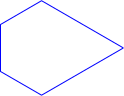
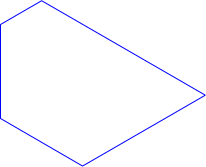
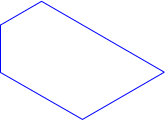
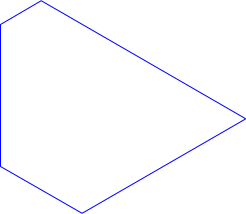
One finds that the faces of the Loday realizations are rectangles or 120°/60°-pentagons. In the 3-dimensional case the shapes of the pentagon faces are
with length ratios 2:1:1:1:2, 4:1:2:2:3, 3:1:1:2:2, respectively. The first pentagon is the Loday realization in the 2-dimensional case.
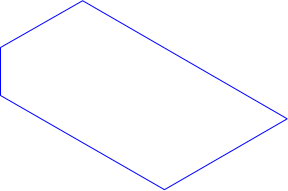
Here are two more examples of 120°/60°-pentagons with length ratios 5:2:1:4:3, 5:1:3:2:4, respectively:
Extending sides
For a 120°/60°-pentagon the corner is the vertex with the unique acute angle (of 60°) and the base is the side opposite to the corner. Moreover, a corner arm is a side adjacent to the corner and a base arm is a side adjacent to the base.
A corner arm is adjacent to a base arm and is parallel to the other base arm. And vice versa.
Extending sides of a 120°/60°-pentagon erects outside equilateral triangles at the 120°-120° sides (the base and the base arms):
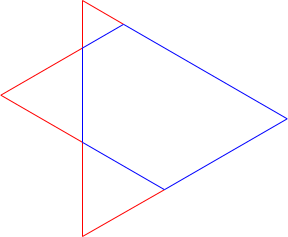
In particular, one gets an equilateral triangle (by extending at the base arms) and a parallelogram with angles 120°, 60° (by extending at the base):
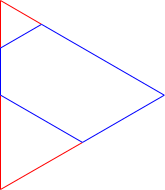
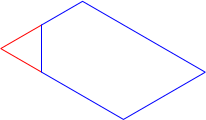
Conversely, the pentagon is obtained by cutting off accordingly two equilateral triangles from an equilateral triangle resp. one equilateral triangle from a 120°/60°-parallelogram.
Clearly, a 120°/60°-pentagon is determined by the lengths of its base and its base arms. The extension to the parallelogram shows:
The length of a corner arm is the sum of the lengths of the parallel base arm and the base.
This follows also from the extension to the equilateral triangle: its side length is corner arm + adjacent base arm = base + base arms.
Date: Spring 2026