
This page is intended as place for newer texts related with quadratic forms, in particular of dimension 2. Another text in this area is
by Markus Rost (Notes, August 2026, 13 pages)
The text presents the solution to the Newton differential equation in the case of negative energy and nonzero angular momentum.
The text is mainly a collection of explicit computations which grew over time.
The point of view is algebraic with no emphasis on geometry or physics.
The material is inspired by Appendix 1. Conic sections in: Milnor, John. On the geometry of the Kepler problem. Amer. Math. Monthly 90 (1983), no. 6, 353-365. MR 707149, Zbl 0518.70008.
Full text (October 4, 2026): [pdf]
The final conclusion on one page. The description is essentially the same as in Milnor, ibid., p.360.
Full text (September 25, 2026): [tex] [pdf]
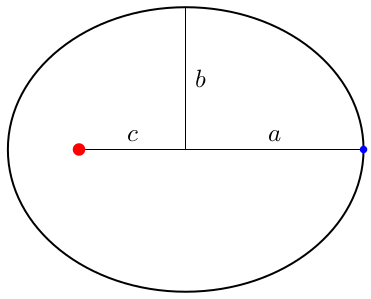
The ellipse with a:b:c=5:4:3.
Let h, p be two symmetric bilinear forms on a 2-dimensional space (over any ring).
Define a quadratic form q and a symmetric bilinear form f as follows:

Caveat: The cross-product × of symmetric bilinear forms in dimension 2 (which form a 3-dimensional space) is a quadratic form. And vice versa. The scalar product underlying the cross-products is given by the determinant (it is indefinite). In the formula, Qh denotes the quadratic form Qh(v)=h(v,v).
Note that f is of degree 1 in p and of degree 0 in h. The symmetric bilinear form f is a scaled orthogonal projection of p along h. (No discussion of the factor and denominator here.)
Example:

Let us define the "focus scheme" of p rel. h by the equations q=0, f=1. It is finite of degree 4.
Interprete h as metric and p as form of a conic section p=1.
Then q=0 yields the axes of the conic section with respect to h (the common diagonalization of p, h).
The equation f=1 yields on the axes 4 points (2 per axis).
In the classical real case, one finds that 2 of the points are real, the other 2 are imaginary. The real points are the focus points of the conic section!

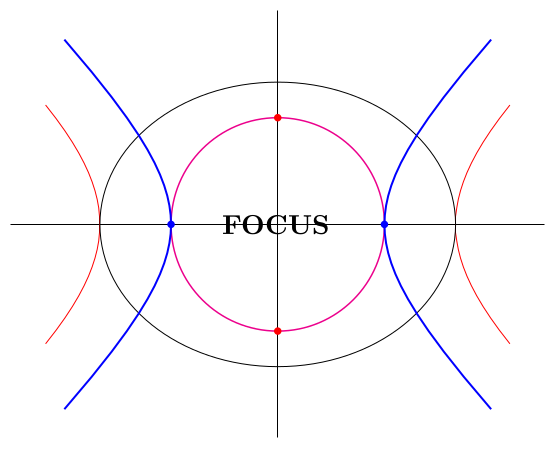
The image shows first of all an ellipse in the (x,y)-plane with equation x2/a2+y2/b2=1 (a>b>0), together with its axes (defined by xy=0) and its 2 focus points (±c,0) (with c2=a2-b2).
The equation f=1 yields the "focus hyperbola" with equation x2-y2=c2 (drawn in blue). Hence the points of the focus scheme are (±c,0), (0,±ic).
In the (x,iy)-plane, the ellipse equation yields an hyperbola (drawn in red) and the focus hyperbola becomes a circle. Note that the underlying Euclidean metric x2+y2 reads here as x2-y2.
The text is in preparation since September 2026.
First very brief sketch (September 9, 2026): [pdf]
TeX/TikZ source for the image: [tex]